Search using the fields below to find a project.
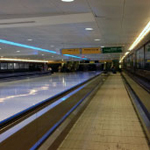
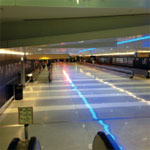
In 1999, American Airlines began construction on a USD 1.4 billion terminal complex on the area of 200,000 square kilometres (50,000 acres) to replace Terminals 8 and 9 at New York’s JFK International Airport. Scheduled to be completed in 2007, the complex was meant to serve domestic and international passengers on three concourses and included a Customs and Immigrations facility, a 930 square meter (10,000 square-foot) retail and concession space, and a new 1,900-space parking garage. To allow for uninterrupted passenger service, the complex was built in four stages.
Part of the terminal construction involved building a new 460 meter (1,500-foot-long), 46 meter (150-foot-wide) concrete pedestrian tunnel, which runs 7.6 meters (25 feet) below finished grade with a water height of 3.6 meters (12 feet) at high tide. During the original construction of the tunnel, conventional PVC waterstop and membranes were used to waterproof the structure.
Before long, however, shrinkage cracks began to form and they, along with the cold joints and construction joints in the walls and floors, began to leak. Over the next 18 months, the foundation contractor tried numerous solutions to fill the cracks and stop the leakage. Despite spending many thousands on repair solutions, the cracks continued to grow, and the tunnel continued to leak.
After a number of failed repair attempts, the foundation contractor contacted the Crystal Group, a Kryton distributor in New York. The Crystal Group offered to undertake a 50-foot test repair using Krystol T1 & T2 Waterproofing System and Krystol Crack Repair System.
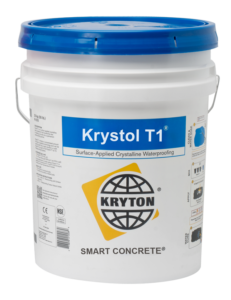
Krystol T1 & T2 Waterproofing System is a cementitious mixture that can be brush-applied to existing concrete structures to repair cracks, fortify and waterproof the concrete and protect it against contamination and steel reinforcement corrosion. After application, chemicals from Krystol T1 & T2 are absorbed into the concrete by the natural wicking action of concrete. Once inside the concrete, the chemicals cause crystals to grow, self-sealing cracks and filling the spaces between concrete particles, permanently blocking the movement of water in all directions.
The active Krystol chemicals will migrate deep into the pores and capillaries of the concrete. Because of this deep penetration, with time the initial surface coating of Krystol T1 & T2 can be removed without impacting the waterproofing properties that the Krystol products have brought to the wall. Krystol T1 & T2 can be applied to positive or negative surfaces where access to outside walls may difficult or impossible.
Once the 50-foot test repair proved watertight, the project team gave the go-ahead for full repairs to begin. The repair team began by grinding out the cracks and joints to remove the epoxy and other materials that had been used in an attempt to stop the leakage. Honeycombed sections where air had not entrained properly were also chipped out. The Krystol T1 & T2 system was applied to all cracks and joints successfully. Even cracks greater than 0.75 mm were able to self-seal when allowed adequate time for crystal growth to occur.
After shrinkage cracks and cold and construction joints were repaired, the Crystal Group used Krystol T1 & T2 to repair a shifting armour joint, which connected two 500-foot concrete tunnel sections. The 87 feet of repairs were made more difficult by freezing temperatures and continuous flow of 40-degree ground water at 15 PSD. Furthermore, the JFK project team wanted to pressure-test the repairs just 7 days after completion, which is earlier than recommended. Despite the adverse conditions and shortened timeframe, the test was successful, and the armour joint proved watertight.
The Crystal Group completed the JFK repair project in March 2004 and to date the concrete pedestrian tunnel remains problem free.
Krystol T1 is a surface applied crystalline slurry treatment that transforms new or existing concrete into a permanent waterproofing barrier.
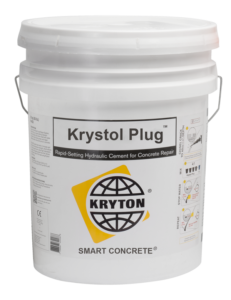
As part of the Krystol Leak Repair System, Krystol Plug is a rapid-setting hydraulic cement product that when mixed with water is used to stop flowing water and repair leaking cracks, holes and joints in concrete.
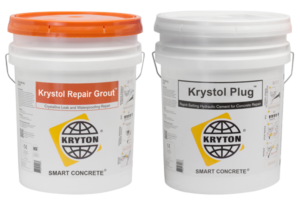
The Krystol Leak Repair System is a permanent crystalline waterproofing solution used for repairing leaking cracks, holes and joints found in concrete. It reliably stops high water flow, even under high-hydrostatic pressure, and outperforms injection systems. Repairing leaks is a simple 3-step process that involves…